

If you get a chance to read my Urban Outlook column in Saturday’s Observer (it’s in the Opinion section of charlotte.com, starting Saturday) you’ll see – no surprise – I’m a huge fan of Jane Jacobs’ writing.
At a dinner Wednesday I sat next to a smart, accomplished local architect who was quibbling about Jacobs a bit, saying she didn’t have what he called real world experience, hadn’t ever designed any buildings and even at one point said her writing was essentially “fiction.”
I didn’t stab him with my salad fork, but I was tempted.
Obviously, anyone in any line of work learns from doing, whether it’s designing buildings for clients, drawing up city plans, writing editorials or building stone walls. Reality – whether in the form of structural engineering, planning department budget shortfalls, or looming deadlines – makes almost anything that any of us produce less than perfect. It’s true, Jane Jacobs never drew up city plans or designed buildings. And it’s true the Greenwich Village neighborhood that she observed most intently for “Death and Life of Great American Cities” wasn’t – still isn’t – a typical New York City neighborhood. But that doesn’t make her work fiction any more than it makes Lewis Mumford’s work fiction.
Jacobs wanted us to trust our eyes and our ears. She scorned, for example, urban planners’ veneration of “open space” as an abstract good, regardless of whether the “open space” ever got used by real people for anything other than muggings.
She saved some of her choicest invective for traffic engineers. In her 2004 book, “Dark Age Ahead,” she wrote that traffic engineers “have abandoned and betrayed science as it is understood. ... It is popularly assumed that when universities give science degrees in traffic engineering, as they do, they are recognizing aboveboard expert knowledge. But they aren’t. They are perpetrating a fraud upon students and upon the public when they award credentials in this supposed expertise.”
She called it an “incurious profession” that “pulls its conclusions about the meaning of evidence out of thin air – sheer guesswork – even when it does deign to notice evidence.”
One example she gave: She didn’t drive and had to take taxis, which charge according to time and distance. To get to destinations in downtown Toronto using the elevated, limited access freeway invariably cost more than to get to destinations downtown avoiding the freeway. Her conclusion: Traffic engineers had planned roads without realizing that drivers have micro-destinations, not just the macro-destination of “downtown.” You could get to the outskirts of downtown quickly on the freeway, but you were slowed as soon as you hit the exit ramps and all the one-way streets, no-left-turns and other engineer tricks that were supposed to ensure a “speedy trip.” Instead, they’re impediments to getting where you want to go, she wrote, because someone apparently told traffic engineers the journey (speedy travel) matters more than the destination (getting somewhere efficiently).
She wrote: “In the background of this paradigm I see little boys with toy cars happily murmuring, ‘Zoom, Zooom, Zooooom!’ ”
Jacobs wanted people to see the world as it is, not just as they were taught in class. It's a useful lesson.
Friday, April 28, 2006
Mourning Jane Jacobs


Thursday, April 27, 2006
Let The ImaginOn Wars Begin
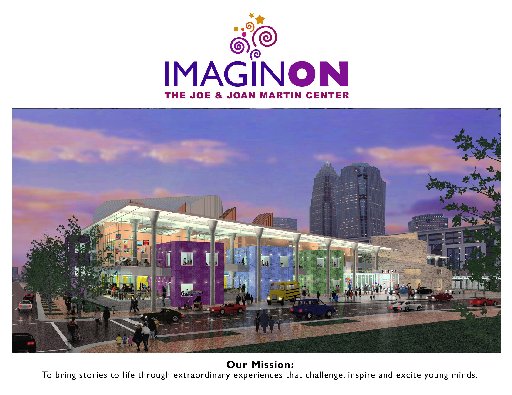
I made a short comment in my previous post about the design of the ImaginOn building, asking what people thought. (Architects, here's your chance.) One reply, from "Rebecca":
"IMAGINON is GHASTLY. The ugliest building I have ever seen. it makes me ashamed every time I pass it. It looks like something my kids built in the woods out of scraps of castoff crap they found laying around. ICKY.”
Several comments complained about what they thought was ineffective use of tax money on the buildings. Others defended the building’s use – as a children’s library and the new home of the Children’s Theatre of Charlotte.
Here’s my take: I love libraries. And the Children’s Theatre is a gem of a resource for the city. We’re lucky to have it, lucky enough theater folks are willing to work there for what I’m pretty sure aren’t great salaries. Our daughter has taken classes at the CT and loved it, so I’m happy that worthy organization has much better, larger and better-equipped space.
I mourn the loss of the old building on Morehead because its walls oozed memories and history. The stairwell wall from the dressing rooms up to the stage was layer upon layer of signatures of Children’s Theatre participants from over the decades. The history had seeped into the bones of the building and was palpable for even the youngest users, and I’m sad that all those memories were just turned into rubble in one day.
BUT – you knew a “but” was coming, right? – it’s dumb to segregate “children’s books” from the main library in a whole other building. That just further isolates young people from larger society. Kids need more places where they’re integrated with, and interacting with, people of all ages from the elderly on down.
In addition, it’s user-unfriendly for two rather large groups: 1. Adults who want to browse and check out books WHILE they take children to the library. Why make them trudge between two buildings several blocks apart? 2. Kids aged about 8-15 who are good readers and move back and forth between “children’s books” and “young adult books” and “adult books.” We should all be encouraging more kids to read more advanced literature if they’re interested, not putting obstacles in their way.
And I confess, I think the building is junky looking. I'm afraid that in 10 years it will look dated, and in 25 years will even be shabby. Our 14-year-old loves it, however. So who’s right? Let the debate begin.
Monday, April 24, 2006
What WAS That Thing Uptown?
Attention, uptown folks: What WAS that? Or downtown folks. Doesn’t matter what you call the place. What WAS that thing I saw on Sixth Street last Thursday?
It was the carcass of what can best be described as a critter.
It lay on the south side of East Sixth, in the block east of College Street, sort of across the street from Brixx. It was brown and furry, with a rodent-ish face, and a furry tail. It was the size of a beaver.
The size and the fuzzy tail ruled out rat, possum or beaver and, based on a quick Google search, muskrat. It wasn’t a rabbit or hare; its ears were small and round. 
Is it possible we have groundhogs – a.k.a. woodchucks, as in "How much would would a woodchuck chuck," etc. – in uptown Charlotte?
"Fried, roasted or stewed woodchuck can be tasty," a Canadian Web site, Hinterland Who’s Who, tells me. No mention of woodchucks having become urbanized like raccoons and possums. Even so, it looked more like a groundhog than anything else, though I’ve only seen them dead on the highway, or standing sentry beside mountain roads or being fêted at the Nature Museum on Groundhog Day.
Any theories, anyone?
Speaking of sights
And speaking of uptown sights, can there possibly be a less distinguished-looking county courthouse than the new Mecklenburg County Courthouse at Fourth and McDowell streets?
One last thought
One last uptown thought: ImaginOn? Love the building or hate it?
My quick take – it’s seriously suburban, with its odd scraps of useless lawn out front. And that grassy berm out back looks as if it was modeled on some suburban buffer in Weddington. It has no place in an urban setting.
Maybe someone with a competitive streak figured if Dallas has a grassy knoll, then Charlotte needs one, too.
Wednesday, April 19, 2006
Son of Big House
A reader shares this link to another article about the Big House phenomenon, and the backlash against it. Her comment, “pretty much same story/justification – if they can afford it and they run you off from your home/ruin your neighborhood then too bad for you. They are rich and you are not so get lost...” Here’s the link: http://realestate.msn.com/buying/Articlenewhome.aspx?cp-documentid=418653>1=8012
And if you’re interested in something a bit less public-policy-wonkish, try this site from Charlotte’s avant-gardista, Little Shiva: http://www.makecharlotteweird.com/home.html
Friday, April 14, 2006
World Class -- What Would It Take?
Reader N.T. poses an interesting question:
I enjoy reading your blogs. Here's a good topic. What will it take to make Charlotte a "World Class City"? Charlotte is a great city with potential to become world class. City Leaders need a broader vision. They also need to prepare the city for the next 30 years, not five. Here are a few of my suggestions.
An education system that provides quality education for all students, in a comfortable environment, and with educators who are professional and qualified to teach all students. An education system that focuses more preparing students for a career and life, not just passing EOG tests.
Better roads and parking; a law and/or medical School; become a 24-hour city; a diverse leadership team; international facilities (schools, parks, banks, businesses) in prime areas such as uptown and South Park. World Class Cities embrace the world.
Once some pieces are in place the city will attract more businesses and cultural attractions.
What's your answer? Here's mine:
Charlotte should stop trying to be a "world-class city" and just try to be a great place to live.
A world-class city has layers of history that reveal themselves to visitors and residents. Charlotte isn't old enough yet, and too much of what could have become its first layers of history has been torn down. That's got to change.
A world-class city has enough people concentrated in the center to create not only the sense of excitement that good cities offer, but to create a market for stores, museums, businesses and all the other things that over time help create those layers of history.
In time, 50 or 100 years maybe, Charlotte might become a world-class city – if its leaders think long-term as well as short-term, if more of its residents support the arts (name a world-class city that doesn't have great art) and will invest public money in great parks and museums (name a world class city that doesn't have them), if its schools stay strong (because bad schools mean a dying center city), if its luck hold up, if the creek don't rise ...
Right now Charlotte's civic persona is so desperate to be "world-class" that it comes off like a teenaged boy who want so desperately to be popular that he runs for class president every year and tries out for all the teams. To want something that nakedly just works against attaining it.
So I think Charlotte should worry less about "world-class" and relax more.
Thursday, April 13, 2006
Some Facts About Growth
Figured I’d weigh in with some facts, to respond to recent comments, mostly about impact fees.
First, while I think impact fees are worth considering, I haven’t said they’re the greatest idea since sliced bread. There are other, probably better ways to find money to build schools and repair streets and fund parks and deal with growth’s costs to local government. Problem is, so far our elected officials aren’t looking at those other ways, either, or using tools they already have (primarily property tax increases) or reallocating existing money.
Second, yes, impact fees would require lengthy political effort. That's one reason they may not be worth fighting for. Another option is some places are using is to adopt adequate public facility ordinances, which need no blessing from Raleigh. Under an APFO, developers can develop in areas where infrastructure’s adequate, or wait to develop until infrastructure catches up, or pay a fee toward creating the infrastructure.
Third, Charlotte-Mecklenburg Schools are not “in the toilet.” Test scores are rising, not sinking, for black, white and Hispanic students. Is that the only way to measure a good education? Of course not. But it’s the only way we have. CMS has some excellent schools, with excellent and hard-working teachers, delivering excellent educations. I’m tired of people acting as if those places don’t exist.
Fourth, there are no proposals before county commissioners or City Council to adopt impact fees. There’s a lot of talk about looking at new revenue options because of a belief that the property tax shouldn’t be the only mechanism with which to raise money. But so far there’s only vague talk.
Fifth, “almost all the new development uptown is because of tax policy and government subsidy.” Say what? Most development uptown is residential and gets no incentives. All over the U.S., urban living became “cool” again in the 1990s and a market arose that didn’t exist 25 years ago, or more likely, a market that existed all along was rediscovered, and with red-lining outlawed it was allowed to flower again.
Yes, the arena and the stadium got healthy boosts from public money. So did the Coliseum on Tyvola Road, by the way. So did the old Coliseum (now Cricket Arena) on Indy Boulevard back in the late 1950s. If you’re tracking subsidies, don’t overlook the outerbelt and its numerous, clogged-with-development interchanges – way more than are needed for transportation purposes. We all paid to build those interchanges, in order to enrich developers and landowners. Remember, too, that Charlotte-Mecklenburg Utilities plans to put sewer service in every square inch of the county, paid for by all off us who pay water-sewer fees. Talk about incentives to develop! Without sewer and water, no development. You may not like government spending that lures development, but it’s been going on for years, all over the place.
Last, “It’s well documented that new urbanism gets legs not because people want to live in urban areas (in fact this year's realtor survey and recent census survey say the exact opposite) but because of financial and tax policy incentives.” Any of you new urbanist developers out there want to set the record straight?
Monday, April 10, 2006
Impact Fees: Public Loves 'Em
An anonymous poster (and sorry, poster-named-Rick, but it doesn’t bug me if they’re anonymous) had this to say about my March 27 post “Developers 1 – Everyone Else, O” (see below): “Impact fees get no traction with the public because we know we pay TOO much already and GovCo makes too many bad decisions.”
Hate to break it to you, but a recent survey just released found overwhelming support for impact fees. Now, the fees may or may not make sound public policy – that’s a whole other question. But they’re enormously popular with the public.
The poll results, released Friday, were plastered all over the Observer’s front page. If you missed Saturday’s Observer, here’s a link.
It was taken by MarketWise, for Mecklenburg County’s School Building Solutions Committee, a.k.a. the Martin Committee, chaired by Republican former Gov. Jim Martin, who, before he was governor was a county commissioner, then a U.S. House representative. The survey was Feb. 21-March 17, and involved 623 phone interviews.
Respondents were asked about four possible alternative revenue sources, worded exactly this way: increasing local sales tax, increasing cigarette tax, a tax on the sale of land, charging impact fees to developers.
On page 30 of the PowerPoint presentation, you’ll find an interesting graph showing their replies: 79 percent of respondents who voted in last fall’s school bond referendum, and 76 of those who hadn’t voted, said they’d support impact fees.
The way it’s worded makes it sound as if developers paid the fees and didn’t pass the costs on to homebuyers, which is what's more likely to happen, although not always. After all, to compete on price, developers sometimes will eat a percentage of the impact fee costs, or choose to lower costs in some other way.
Anyone who isn’t planning on buying a new house is going to think impact fees are a great idea, and a sales tax – which everyone would pay – is a crummy idea. The poll results show exactly that: 25 percent of voters and 23 percent of nonvoters liked the sales tax idea. The tax on the sale of land (also known as a real estate transfer tax) got support from 39 percent of voters, 36 percent of nonvoters, and the increase in cigarette taxes got 76 percent support among voters and 79 percent support among nonvoters.
Reality checks: The cigarette tax is a state tax, not locally adopted. All three other local option taxes require the N.C. General Assembly to give its blessing.
If you’re among the many who think impact fees are a good idea, don’t be beating up on your school board members. They have nothing to do with impact fees. They can’t levy any taxes at all.
Find your state representatives in the N.C. House and N.C. Senate (Here's a link to help you find your representatives. You'll need your Zip Code-plus-four) and beat up on them. THEN call Charlotte City Council members and Mecklenburg County commissioners . They’re the ones who’d have to adopt the fees if the state allowed it. And they'd surely have to lobby the state, too, just for permission.
And if you don’t like impact fees, tell them that, too. I’d rather they be listening to the whole realm of public opinion than just to the developers.
Tuesday, April 04, 2006
Trains to Planes? Not Here
The planning commissioners practically pounced on the CATS guy.
CATS Deputy Director John Muth had just finished briefing the Charlotte-Mecklenburg Planning Commission on Monday on the status of the transit system. (Headlines: South Corridor trains running by fall 2007, many decisions to be made summer and fall on which corridor goes next, whether the West corridor gets light rail, bus rapid transit or streetcars, etc.)
Then several commissioners began suggesting to Muth oh so nicely that CATS really, really, really needs to make sure the West transit line goes to the airport.
Because right now, with the still-tentative plans, it wouldn’t. The likely route would go down Wilkinson Boulevard, not to the airport terminal.
Planning commissioner George Sheild, a developer, probably summed up the sentiments of many others: “I think a really good rail connection from the airport to downtown would do more for Charlotte than the whole South Corridor.”
Anyone who’s ever traveled in or out of a city with good transit connections to its airport – Washington, London, even St. Louis – knows how easy it is to arrive, walk down the hall or down some stairs, and get into a train or bus or tram. Cheaper, too.
Muth was pleasant, but noncommittal.
There’s just one problem with everyone’s wishes on this: The federal money for transit comes with strings attached. One string – more like a rope – is that the project has to meet a cost-effectiveness test. The feds set the rules for how you calculate cost-effectiveness, involving projected ridership, time saved by riders, etc. Those federal rules got even stricter in the past year.
The early numbers on the West Corridor showed light rail to the airport wouldn’t pass the cost-effectiveness test. That’s because not enough people go to and from the airport. Most of the people using our airport – a longtime US Airways hub – are just switching planes.
Muth said some new pots of federal transit money are available for smaller-scale projects, and CATS is looking at whether it might be able to use those pots to fund streetcars in the West corridor as well as the “Streetcar” project it plans for Trade Street and out Central Avenue. Streetcars cost less to build, because they run in the street, but they’re slower – because they run in the street, with the other traffic. And the federal money in those newer pots don’t pay as big a percentage of costs.
Transit to the airport? I’m all for it. I hope CATS and the airport and the city can figure out how to make it happen.
But I don’t think it’s likely, at least not in the next 20 years.
Monday, March 27, 2006
Developers, 1 -- Everyone Else, 0
At bottom the problem with what happened Friday wasn’t even that the developers’ lobby – as usual – got to tell a group of elected officials why, in their opinion, adopting impact fees to help pay for Mecklenburg County schools would lead to economic collapse and quite possibly the end of life as we know it. (I’m exaggerating less than you might think.) The problem was that most of the rest of the citizenry, many of whom think the county is insane not to have impact fees, didn’t get equal time.
The song and dance from the developers was as inevitable as the azaleas popping into bloom in spring. The intergovernmental planning committee that’s been looking at growth and schools and trying to devise recommendations had, months back, included the words “impact fees” and “adequate public facility ordinance” on a long list of recommendations to consider.
I knew the developers’ lobby doesn’t even want those words to surface on the committee’s list of options to consider. Friday, it got to make its case.
The Planning Liaison Committee meets monthly at the inhospitable hour (at least for night-owl journalists) of 7:45 a.m. Its members are two or three representatives each from the city-county planning commission and all the elected bodies in Mecklenburg County.
I’m interested in how this community deals with – or doesn’t – rapid growth that has outstripped its ability to build schools, so I’ve been attending fairly regularly for two years. Usually I’m an audience of one. But when they started mentioning impact fees, Mary Thomsen and Tim Morgan of the Real Estate and Building Industry Coalition began showing up.
Friday the room was packed. The PLC had invited REBIC, the Charlotte Chamber’s land use committee and the local chapter of the American Institute of Architects to offer thoughts. (Aside: The architects’ presentation was organized, thoughtful and deserves more publicity than I’m giving it in this posting.)
Key fact coming: The PLC has no authority to do anything. They just talk, and suggest that members take ideas or recommendations back to their respective governing bodies. So essentially, this was a way to give REBIC and the Chamber an audience that you and the rest of the public didn’t get and won’t.
Mark Cramer, REBIC’s executive director, showed a cheery video from the state homebuilders’ lobby. (“Does homebuilding actually pay for itself?” the video intones. “The answer is an emphatic yes,” and the screen shows a “YES!!” in large capital letters.)
REBIC contends impact fees raise the cost of housing so much they drive away affordable housing and send development to outlying counties, which is a legitimate issue that ought to be considered during any pros-and-cons discussion. (So, I might add, should the possibility of structuring impact fees so they apply differently to apartments and smaller houses, so low-income families aren’t as seriously affected.)
And so should the concept that having a crumbling, overcrowded school system will drive away just as much development – and be just as bad for lower-income families – as slightly higher home prices will.
Here’s the real problem: Building enough schools will take money and it must come out of somebody’s pocket. The questions for the community ought to be: Whose pocket, and how much, and what is the fairest and – important point here – most politically feasible way to find the money?
All the options have pros and cons, and they should all be discussed openly. The developers should not be allowed to pull off the table the one or two options they happen not to like.
I’m not even sure impact fees are the best way to go. A land transfer tax will raise more money and be more broadly based. But developers and real estate lobbyists hate that one, too.
The elected officials treat the developers’ lobby and the Chamber as if their opinions are more important than everyone else. But we all have skin in this game, not just REBIC.
Raise your hand if your kids or grandkids go to an overcrowded school. Raise your hand if your kids’ school is in terrible need of renovation and repair. Raise your hand if you moved here from a place where impact fees are routine and the place hasn’t suffered from total economic collapse. Raise your hand if you think Mecklenburg County should consider them as a way to raise a bit of money to build more schools.
Guess what? You are cordially NOT invited to make a presentation to the Planning Liaison Committee. They’re too busy hearing from the developers.
Thursday, March 23, 2006
He spoke for the trees
I popped in at the City Council’s zoning meeting last Monday night. When you do that, you almost always stumble over some great tidbit.
Monday’s came during a public hearing on a request to rezone about 5 acres off Tuckaseegee Road for an office and a self-storage facility. The planning staff was recommending against the rezoning, because it doesn’t match the plan for the area. One area of contention was that the planners want the developers to save 17 percent of the trees on the site. The developers say that isn’t feasible.
At that point council member Michael “The Lorax” Barnes spoke for the trees. He said he found it unacceptable to disregard the city’s tree-save requirements and suggested the developer consider options for mitigating the damage, such as planting trees elsewhere. It’s a novel idea – who knows if it’s workable? – and I loved hearing a politician offer such a thought.
Then the developers’ lobbyist, Bob Young, spoke up: “I like trees,” he avowed. “We all like trees.”
Well, yes.
It reminded me of when the city, in 1998, was proposing requiring developers to build sidewalks on both sides of subdivision streets, a proposal that drew sharp opposition from the Real Estate and Building Industry Coalition. They just loved sidewalks, of course. But at one council meeting, after pleas for good sidewalks on behalf of children, the elderly and people in wheelchairs, REBIC executive Mark Cramer warned council: “You can have too much of a good thing.”
Like trees, I suppose.
Tuesday, March 21, 2006
House Bloat
Today’s topic: Bloated houses. 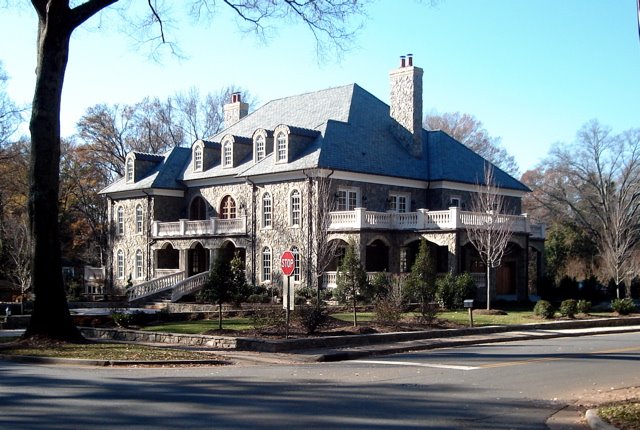
It’s on my mind for a couple of reasons. First, the City Council on Monday night had a public hearing on whether to created a local historic district for the Hermitage Court area of Myers Park. The majority of the property owners on the street support the historic district, which would bring the possibility of up to a year’s wait if someone wanted to demolish a home. So it wouldn’t stop the teardown frenzy, but might slow it some. And Myers Park is being ravaged by teardowns. Consider the "starter castle" (above) on Queens Road West.
But here’s the other reason it’s on my mind. A friend sent me this link to something the alternative weekly Austin Chronicle has put online: Its Bloat-O-Meter. People send in photos and then online voters rate it 1 to 10, a 10 being “McMansion.”
What’s a McMansion? We all have different definitions, I suppose. To me it’s a pretentious new house built in a place where it’s too big for its neighbors, in many cases too big for the lot, and typically with a national-franchise predictability to its architecture (using the term loosely). Just being new and ugly doesn’t make something a McMansion. Being oversized and too show-offy are key ingredients.
I confess to having heightened sensitivity, because I live in a neighborhood where ’50s ranch houses are being torn apart, house by house, and replaced by houses with upwards of 6,000, or even 8,000 square feet. To my knowledge, only one of the families moving into the big new houses has enough kids to truly need that many bedrooms.
The construction has been unrelenting for five years. Builders rip out huge trees. They allow eroding dirt to pollute our creek. Construction trucks block the street, crack the pavement and gouge tracks in our lawns. While our property value has soared, that’s only worth something to us if we sell our house and move. Meanwhile, it means our property taxes have also soared. We used to think we could retire there. No more. The taxes will drive us out.
But enough about me. Take a look at the Austin Bloat-O-Meter. Don’t you think our McMansions can beat their McMansions any day of the week?
Friday, March 17, 2006
East, West Charlotte treated unfairly?
Not surprising, really, but the two most affluent City Council districts, 6 and 7, have only a tiny proportion of the city’s federally subsidized Section 8 voucher rentals. The vouchers help low-income households pay for rents they otherwise couldn't afford.
The breakdown of where the vouchers go has been eagerly sought by East Charlotte neighborhood activists, among others, who think their part of town holds a disproportionate share of government-funded affordable housing. The Observer’s Karen Cimino acquired the breakdown – which is public information – from a GIS analyst in the city’s Neighborhood Development department.
Her article Thursday in the Neighbors of University City section ought to generate some interesting talk.
(Cimino tells me her earlier requests to the Charlotte Housing Authority for Section 8 vouchers sorted by Zip code still haven’t produced the data. Guess it takes a City Council member – in this case District 4 rep Michael Barnes, who asked city staff for it – to spur some public agencies to make public information public.)
The breakdown is by City Council district, which makes it a bit tough to analyze in an East Charlotte v. West Charlotte v. South Charlotte kind of way. That’s because District 2, for instance, covers chunks of what would be considered West Charlotte as well as University City (northeast Charlotte); District 5 covers parts of East Charlotte and South Charlotte; and District 1 covers all the way from Dilworth to chunks of East Charlotte.
But the numbers are stark: The affluent, predominantly white District 7 (far south Charlotte) has 34 Section 8 vouchers. District 6 (closer-in south Charlotte) has 193. Even their combined total of 227 is dramatically less than any other single district.
District 3 (generally west and southwest Charlotte) leads with 921. District 2 (generally northwest, north and northeast, and with more than 5,000 more housing units) is next with 917. The predominantly east Charlotte District 5 has 757, with District 1 close behind at 754. (Note that District 5 holds 4,500 fewer housing units than District 1). District 4, which is most of University City, has 588.
Some caveats: Landlords have to voluntarily apply to receive Section 8 vouchers from renters, so those in high-demand, more affluent parts of town have little incentive to enroll in the program.
Federal policy supposedly is to try to spread Section 8 housing around, so as not to overburden one neighborhood. It doesn’t seem particularly effective, from what the numbers show. The city says it wants to do the same. But the marketplace, left to its devices, isn’t accomplishing that.
Why care? Because when too much low-income housing gets too concentrated, property values throughout that area drop, undercutting the the city tax base. And that means higher taxes for all of us.
Experience has shown that a small percentage of affordable housing units sprinkled lightly through affluent areas don’t affect property values. Why doesn’t the city require all housing developments to include a small percentage of affordable units? Other cities do this, and it works well.
It prevents the stark economic segregation we’re now seeing in Charlotte.
Tuesday, March 14, 2006
Charlotte tourism -- Oxymoron?
I’ve always thought the people who say there’s nothing to do in Charlotte aren’t looking very hard. We have art museums, history museums, frescos all over uptown, gallery crawls, all kinds of live performances, lectures and seminars, great restaurants and a ga-zillion bars. There’s enough stuff to do that if I found $10 million in untraceable drug money and could quit my job I could easily fill my time as a gadabout.
Then our family hosted a 13-year-old French kid for two weeks. She was part of a student exchange program at our daughter’s school, a public magnet school called Smith Language Academy. Our kids had visited Limoges (one of Charlotte’s Sister Cities) two weeks last fall. This month, the French kids came here. Now I understand the tourism problem.
When our kids were in France, they visited Versailles and the Eiffel Tower, several medieval villages, and the famous cave paintings of Lascaux, as well as the medieval center of Limoges. Turns out there are Roman ruins below the school the kids attended there, and they went down to see them one day.
The day after NASCAR awarded its Hall of Fame to Charlotte, Atlanta Journal-Constitution columnist Jeff Schultz wrote: “The NASCAR hall of fame instantly becomes Charlotte’s top tourist attraction. The elevator in the Wachovia building drops into second.”
I’m not a huge NASCAR fan, but I think we’d have taken those French kids to the Hall of Fame in a nanosecond. And the whitewater center, if it had been open.
You know, 13-year-olds are not, as a group, your best art museum aficionados. Carowinds isn’t open yet. The whitewater center isn’t built yet. Because the crowd of 19 had only six boys, the Charlotte parents who were organizing their activities opted against Lowe’s Motor Speedway as an attraction.
So what did they like? The girl who stayed with us liked shopping malls. All the kids seemed to enjoy a Bobcats game. I’m pretty sure the group did ride an elevator in a tall building uptown, but it wasn’t their No. 2 activity. It was more like No. 6.
I still think there’s a lot to do in Charlotte, but it does help to like birds of prey (they visited the raptor center), Charlotte history (not a topic taught extensively in Limoges) and art museums. So from now on, when those tourism experts tout Concord Mills and Carowinds as tourist attractions, I no longer will sniff at the concept.
Tourism wasn't really the point of the exchange, of course. The French kids learned a lot about Americans and American family life. Everything here is so big, they said. Americans eat more than they do, I was told. The huge trucks on the streets and roads interested the French kids.
And one day we were in a huge hurry, and we bought Wendy’s hamburgers and ate them while driving on the interstate. This, I thought, is the total American family experience!
Overall, the kids seemed to treat the trip as a grand adventure and to have a great time, regardless of tourist attractions.
But as tourists, what did they like best? I’m pretty sure it was the overnight trip to Charleston.
Wednesday, March 08, 2006
NASCAR's UFO has landed
About that NASCAR Hall of Fame: You may be cheering. Or maybe you doubt it will bring in either the people or the money projected and think the city made a stupid deal.
Forget that for the moment. I’m more worried about the building itself. If you care about uptown design, you should be, too. Feel free to add your comments below.
What I see in the renderings released so far make it look like a flying saucer hunkered in a parking lot. (I'll try to add a link, below).
Yeah, yeah, it has a fancy architect – Pei Cobb Freed & Partners. That’s Pei as in I.M. Pei, ultra-famous architect who designed the glass pyramid at the Louvre and the Rock and Roll Hall of Fame and Museum in Cleveland.
But if you’re going to build in this city – in any city – you need to understand urban fabric. It’s what makes cities and city streets and sidewalks interesting places. Paris has it, and, I assume, Cleveland. In those places, you need a break here and there from the urban fabric. Charlotte has precious little of it. New projects should help create it, not obliterate any opportunity.
Urban fabric means a lot of very small threads, woven close together. Like any ecosystem, a city needs tiny organisms: coffee shops, apartment buildings, stores, doctor’s offices, rowhouses, Chinese take-out places, pizza delivery joints, bars, cleaners, day-care centers, condos, French bistros and Italian trattorias, banks, insurance offices, antique furniture restoration shops, boutiques, art galleries – all in close proximity. Huge, single-use buildings in huge-single use blocks pretty much obliterate any hope of urban fabric. That’s why you don’t want them clustered together.
Second Ward, where the hall is planned, is a veritable monument to Bad City Planning Circa 1960. It is scarred by too many leviathan-sized projects that destroyed the old street grid: the government center, the Convention Center and its hotel and the Education Center-Marshall Park-First Baptist megablock, among others. Big blocks make boring neighborhoods and worsen traffic congestion.
The city’s planners know this. That’s why, in the Metro School rebuilding, South Davidson Street is being extended to Stonewall Streets.
The area around the Hall of Fame is dead, dead and more dead. Dead as in butt-end of the convention center loading docks. The last thing it needs is another gigantic-footprint building. The city – which will pay to build the building – should demand better.Interestingly, the city uses your tax money and mine to pay the salaries of a staff of urban designers in its planning department. They haven’t been consulted about the NASCAR hall design.
The city engineering department has taken the lead so far. Now, I value engineers. Without them bridges would collapse and skyscrapers tumble. But most engineers don’t know diddly about urban design. Maybe that’s why the city has eagerly planned yet another overstreet sidewalk, to connect the Convention Center to the Hall of Fame-new Convention Center ballroom complex. This despite haranguing for decades from planners that overstreet passages are fatal to a lively street scene.
So, let’s see. If a developer wants to build one, the city nixes it unless it’s B of A or Wachovia in which case the city curls into the fetal position. But when the city wants to build one, it’s OK?
Stay tuned. Whatcha bet the city will want to exempt itself from its own sign ordinance, too?
To see the rendering: http://www.belongshere.com/halloffame.html
Friday, February 17, 2006
A cure for Charlotte streets
Sometimes I think I’ve plopped into an alternate universe. Can it be the Charlotte Department of Transportation giving PowerPoint presentations on the importance of making city streets welcoming to pedestrians and bicyclists, as well as cars?
Ten years ago, if I’d heard that it would have meant I’d fallen, cracked my head on a rock and was hallucinating. Back then CDOT acted as if “transportation” meant only “motor vehicles.” Sidewalks, if built at all – and they weren’t required on many subdivision streets – were a stingy 4 feet wide and hugged the curb, right next to 50 mph traffic. Bicycle lanes? Why bother? Nobody rides bicycles in Charlotte! To “improve” transportation efficiency you just made all intersections wider and – if possible – added lanes wherever you could afford to (which, thankfully, was too expensive to do everywhere).
In a few spots, like where rich and/or politically influential people lived, the city proved it was “neighborhood friendly” by forbidding turns onto those sacred streets or even flat-out closing off streets. (Example: East Kingston at Euclid in Dilworth.)
So Tuesday night, at the “Sweet Streets” presentation – part of an ongoing monthly lecture/program series called Civic by Design at the Levine Museum of the New South – it was almost other-worldly to hear CDOT planner Tracy Newsome and her boss, Norm Steinman, CDOT’s planning and design manager, list changes they’re proposing to the city’s street-design standards. No, this isn’t asphalt quality or storm drain engineering. It’s about how wide or narrow streets need to be, how wide and how far from the street sidewalks should be and the importance of short block lengths and having plenty of street connections. Would you believe me if I said I think Jane Jacobs would approve?
What Newsome (no, we’re not related) and Steinman and their boss, CDOT Deputy Director Danny Pleasant are pushing is pretty much the whole philosophical approach that I and plenty of other people in town have wanted the city to adopt for years. The project’s bureaucratic name is the Urban Street Design Guidelines. They’ve been in the works at least four years – my first notes on the subject say April 2002. One early draft came out in 2003. The city’s Web site has the current draft.
Why haven’t they been adopted yet? One possibility: There’s been plenty of pushback from developers, who don’t like it whenever city rules get tighter and who specifically have complained about shorter block lengths (i.e., more pavement required, and in some cases developers may not be able to get as many lots onto a subdivision site) and about wider, 8-foot planting strips – which Newsome and Steinman say are needed if you want street trees to survive and grow. In response, CDOT has already loosened the proposed block-length requirement.
Another possibility: The city manager’s staff – as always – frets that developers will whine, City Council members will listen to the developers and the staff will acquire even more scar tissue. Well, it has been known to happen.
The CDOT folks Tuesday night said the proposals aren’t being offered for adoption yet, in order to go through yet another mind-numbingly bureaucratic review process (my words, not theirs). I figure that will take months.
That’s stupid. Adopt the street design guidelines. Now. They’re good, they’re badly needed, and they will make our city better.
If you want to pushing this much-needed improvement onto City Council’s agenda, let your council members know. Tell them you support the Urban Street Design Guidelines and want them adopted now. And if you’d like to be notified of the monthly Civic By Design forums, please notify Tom Hanchett at the Levine Museum of the New South.
Tuesday, February 14, 2006
Does Charlotte have a soul to love?
I figure any column that brings similar responses from avant garde-ista Little Shiva AND civic stalwart Frank Bragg must have hit a nerve. (Feel free to add your own responses, below.)
Last Saturday’s Urban Outlook column was about learning to love Charlotte after living here 28 years. (Ouch, typing that “28” still hurts.) Compared with places like Boston, San Francisco, New Orleans, Asheville, or even Fayetteville, Charlotte’s personality is, well, elusive.
Years ago, I was at a job-recruiting fair trying to meet promising young journalists who might want to work for The Charlotte Observer. One photographer stopped by the booth, and we chatted. She asked, “Does Charlotte have a soul?”
Long pause. Remember, I was being paid to make people think they’d want to work here. Finally, I came up with a convoluted response that I hope didn’t sound too desperate. It went something like this: “Charlotte’s soul is subtle. You have to live there a while before you can figure out what it is. It’s hidden, sort of ... ” The photographer never, to my knowledge, applied for a job here.
I wrote, years ago, that Charlotte may have no “soul,” per se – although some people pointed out to me that the city probably does have a soul, just not one I approve of. Whatever.
Anyway, several people I’ve talked to about my Saturday column – one has lived here 30 years – have confessed to ongoing ambivalence about Charlotte, but that they’re starting to suspect that they, too, may be feeling more affection for the place.
Little Shiva, if you haven’t run into her, is a graphic designer and artist who publishes an underground magazine called QZ and who generally makes Charlotte a more interesting place to live in. She wrote:
“Just wanted to tell you that I like your Charlotte Valentine in today’s paper. I’m not quite ready to say the same for myself, but I feel like I might be someday. I’m not as far along as you, having just gotten here in late 1999. I’m still not in love with this place. ... In spite of my family roots here and in spite of the fact that I’ve been fairly well accepted, I’m still dreaming of Mr. Right (referring to some dream city).
"But I have to look at how far I’ve come since 1999, all the commitments I’ve made towards Charlotte, personally as well as creatively, and I have to realize that this dopey town has somehow become a part of me. Whether or not I ever leave, or just keep this as home base and travel a whole lot more, Charlotte will be a begrudgingly fond chapter in my life story."
Frank Bragg, by contrast, is a successful financial adviser and a well-known philanthropist and civic activist – very “establishment,” if you will, and a decidedly different style than Little Shiva. It was Frank and Kathy Bragg, for instance, who recently donated $100,000 to start an endowment fund for the Chamber Music at St. Peter’s concert series.
“Loved your article about your gradual coming to love Charlotte. I feel the same way. Kathy grew up here and we have lived here 43 years ... except we have always lived outside the city. First south, at Elm Lane and Providence Road West on a small farm (now totally developed ...) and then on Lake Norman for the last 16 years. ... But now we live in Fourth Ward in a condo. We bought it in 1999 and lived here only part-time until last August when we sold our lake house. We love the city. It is exciting, stimulating, and beautiful.”
Thursday, February 09, 2006
Planners’ New Urbanist Utopias crash into reality
Planners are always coming up with Utopian ideas. Then those ideas get heaved against the plaster walls of the real world and shatter like porcelain teacups. (Feel free to share your war stories on that front, below.)
“Live-work units” – they’re all the rage among planners, and some developers, all over the country, especially (but not exclusively) in New Urbanist-styled neighborhoods. They’re buildings with retail or business space on the first floor and homes on upper floors.
It’s easy to see why they’d be popular: They’re an unfilled niche in the development market, aimed at people who own small businesses and don’t want to have to pay to rent/own both a home and a business site, or who don’t want to have to commute. Planners like them because they’re “mixed use” and, among other praiseworthy attributes, cut down on how many auto trips people have to make.
Plus, they can increase a city’s stock of affordable housing if you figure that not having to shell out for a separate space for your business gives you more money for your home.
Here’s the wall that they hit: Building codes don’t recognize them. If you’re a developer trying to build live-work, you’ll probably have to build the whole building under the commercial building code, even residential floors. That pushes your building costs so high that – guess what! – it isn’t affordable any more, and the units may not be able to compete with other residential development on the market.
I wrote a column in the Observer a few weeks ago about the difficulty developers have when applying the state’s building codes to mixed-used buildings. It spurred a call from Jim Bartl, Mecklenburg County’s director of code enforcement. He knows all about the live-work problem. “We’re getting pummeled by it all across the country,” he said.
Bartl, an architect, is one of North Carolina’s unsung heroes for his successful push to revise North Carolina’s state building code to make renovating older buildings dramatically easier. (That change, first enacted as a pilot project, was made permanent last year. Builders, planners, historic preservationists and downtown revitalizers all over the state should applaud Bartl and state Sen. Dan Clodfelter, D-Mecklenburg, among others.)
Turns out Bartl is working with a national committee to change the International Residential Code and the International Commercial Code – the documents that underpin North Carolina’s state building code – so they recognize live-work units and make it easier to build them without compromising safety and fire standards. The committee will submit its proposal to the International Code Council in March. It could be adopted by spring 2007, and North Carolina’s building code would likely adopt the changes after that.
It wouldn't get us anywhere near Utopia, of course, but it should make mixed-use and New Urbanist development a bit easier in the state of North Carolina.
Friday, February 03, 2006
A big win for neighbors
Big news – and good news – out Central Avenue.
The developers who wanted to build an Aldi grocery store at a key intersection – Briar Creek Road – are withdrawing their request for rezoning.
Chris Ogunrinde of Neighboring Concepts, one of the developers, told me Friday they decided to cancel the plans for the Aldi after a meeting with neighbors Jan. 26. “We had a lot of resistance from the residents,” he said. “I told Grey (Poole, the other developer) we should just fold and come back again.”
The property is owned by longtime East Charlotte resident and activist Nancy Plummer, whose husband, Ray, died last year. It’s 4.5 acres, zoned for 22-units-per-acre multifamily.
It was an unfortunate proposal for a key site, just beyond the funkily reviving Plaza-Central business district. The neighborhoods nearby, Merry Oaks, Briar Creek/Woodland, and the fringes of Plaza-Midwood, have in the past 10 years attracted a lot of younger, “creative class”-type residents.
But Aldi is a low-cost chain store that caters to, well, people looking for low-cost groceries. In and of itself, that’s fine. But one way retailers keep costs low is to build fast, cheap, unattractive stores. That’s why they’re called “big boxes.” Look at Costco. Look at Wal-Mart, and Target. Aldi is no exception. Unlike Harris Teeter and the locally owned Reid’s – which built stores uptown in mixed-use buildings – Aldi has no “urban” prototypes, at least, none in Charlotte.
So that key spot was going to get a one-story, suburban-style store catering to low-income customers. And what it needs is a well-designed, urban-style project with mixed-use buildings, good sidewalks and one-of-a-kind shops.
Ogunrinde says he was upset that some of the opposition focused on Aldi’s perceived clientele. That’s a fair point. City planners, as well, aren’t supposed to take such things into account in assessing whether to recommend for or against rezonings. And Aldi customers come from all income groups, surely.
But come on. In the real world developers set “price points” for their developments, and retailers do, too. That’s why Nordstrom didn’t plop itself down next to Target on South Boulevard. An Aldi would signal to every potential Central Avenue retailer and home-buyer, “downscale neighborhood here.”
Given that Aldi would build only a one-story building and needed a big parking lot, from what I saw of the site plan even a good urban designer like Ogunrinde couldn’t do much with the site.
The city plan for the area calls for something different – “neighborhood-oriented businesses” along that stretch of Central. It specifically recommends a coordinated development of the Plummer property and the property across Central, owned by the Renfrow family. It envisions two- or three-story buildings, with retail below and office or residential above.
That's one reason a lot of neighbors felt betrayed by the development proposal. You can feel the heat, just reading the transcript of the Jan. 26 meeting.
The good news: Ogunrinde said he and Poole plan to simply buy the property outright from Plummer, and come back with a different proposal. There’s a lot happening in the area, and property values are rising. The proposed Morningside development, less than a mile away, is expected to set a much higher standard for design. I suspect Poole and Ogunrinde can sit on the property for a year or two and still make a pretty penny.
One other thing: At one point in the neighborhood meeting, Poole referred to the proposed development as “New Urbanism.”
It wasn’t. Not close. I hope people who heard him know the difference.
Wednesday, February 01, 2006
Your protection against government secrets
Want to know who’s trying to get the corner lot rezoned to build a Wal-Mart SuperCenter?
Want to know which City Council members voted for a stronger tree ordinance? Want to know who donated money to candidates in last fall’s City Council election? (Answer: Probably developers.)
Want to know how much the top staff in Charlotte-Mecklenburg Schools’ superintendent’s office are being paid?
You can find out all those things and plenty of other stuff, because government records in North Carolina are open to the public. They have to give you the information, even if they don’t approve of how you might use it.
Government meetings are open, too. They have to let you in, unless the meeting’s about a few very carefully defined topics, such as hiring/firing, or legal advice.
That’s why the Observer’s reporters have been able to write about the lengthy list of violations found over the years at Liberty Nursing and Rehabilitation Center, where resident Mary Cole went missing for four days, and died shortly after she was found in a storage closet. (Today’s coverage )
That’s why Observer reporters could find out that the Synthron Inc. chemical plant in Morganton – which exploded Tuesday – had been assessed $87,600 in state fines in the past five years for serious hazardous waste violations.
That’s why an Eastover couple fighting a developer’s plans to build houses in the floodplain could inspect every floodplain development permit issued in the county.
In other words, if you care to learn what your elected officials and governments are doing with your tax dollars, open records and open meetings laws ensure that you can.
Of course, governments now and again try to get around the law, because sometimes they don’t want people to know what they are up to, either because they’re up to no good, or – as is more often the case – they suspec what they’re doing could get them in political hot water. Most reporters have war stories about county boards holding illegally closed meetings, or bureaucrats who refuse to give you public records.
That’s why neighborhood activists should think strongly of joining the other folks who’ll be among the crowd – historians, librarians, lawyers, elected officials, etc. – at a March 13 conference in Raleigh, “Are We Safer In The Dark?”
Sessions include forums with top lawyers who deal with open government issues, as well as the broadcast of a panel discussion from Washington, D.C., of experts from around the country discussing government secrecy and other open government issues.
The March 13 conference is sponsored by the N.C. Open Government Coalition, a nonprofit and nonpartisan organization dedicated to ensuring and enhancing the public’s access to government activity, records and meetings.
The conference is at Exploris, 201 E. Hargett St., in Raleigh. Cost is $30, including lunch. A registration form is on the coalition’s web site.
Thursday, January 26, 2006
McMansion Madness
Did you hear that Atlanta has halted the teardown-McMansion syndrome that’s overtaking its popular intown neighborhoods?
As an Atlanta Journal-Constitution’s Jan. 20 article reports, it’s a temporary moratorium that stops construction permits in five intown neighborhoods: north Buckhead, Virginia-Highland, Morningside-Lenox Park, Ansley Park-Sherwood Forest and Lake Claire. On Feb. 6 the Atlanta City Council will decide whether to extend the moratorium 120 days and study proposed regulations on height, how close to the street houses can be built, and how much a lot can be raised by adding dirt, among other things.
Dang right it’s controversial. One person’s so-called right to do whatever he or she wants with his or her property (to wit: building a 7,000-square-foot home to tower over the neighboring ranch houses, thus reducing them to the visual status of doghouses) collides with the so-called right not to have one’s historic neighborhood devastated by bloated, out-of-character houses. But is that really a right? (I’m pretty sure it isn’t, though it may well be an admirable and useful goal in some cases.)
What’s in Atlanta’s best interest, long-term? And should Charlotte consider anything similar?
To answer the second question first, yes – but qualified. Some of Charlotte’s most valuable, historic neighborhoods – Myers Park, Eastover and, to a lesser extent Dilworth – are being ravaged by teardowns. Parts of Dilworth are in a historic district. That can delay a teardown and requires new construction to try to fit in.
But old Myers Park is being dismantled, house by house. I wrote two years ago about the David Ovens home (yes, the auditorium is named for him) on Ardsley being demolished. The out-of-proportion 17,000-square-foot house on Queens Road West at Princeton has damaged that street's once harmonious proportions and has become the butt of numerous jokes. Those are just two examples among many.
Even more insidious if not as well-publicized is that smaller, older houses are often the targets. I know Myers Park is more expensive than a lot of neighborhoods, but it’s losing any vestiges of economic diversity, as the small and older houses are bulldozed. And the inflated property values are pushing taxes beyond the reach of people on fixed incomes. Wiser heads should step in, before one of Charlotte’s few nationally known neighborhoods is obliterated.
I don’t know if the answer is a historic district, as in Dilworth, or design review before construction (akin to what Atlanta seems to be proposing), or a neighborhood conservation district. I do know one of the city’s treasured neighborhoods is at risk.
But overall, are teardown McMansions a bad thing? A good thing? Inevitable?
It’s good for a city when lots of people want to live close in. It’s good for the taxpayers that the property values are being inflated – that may help make up for all those high-foreclosure neighborhoods where values are sinking. Better for us in Charlotte if those big, expensive houses are paying taxes here, not out in Weddington.
However it’s not good when neighborhoods lose economic diversity – which seems to be happening.
And it’s not good – it is, in fact, appalling – that perfectly good, solidly built houses are just being thrown away. I’ve been watching a two-story brick home on Wendover Road – the kind of house that when I was a kid, we used to daydream about living in – being knocked down and its remains carted away, presumably to the landfill. It’s a waste of natural resources that verges on criminal. This is a city with painful housing needs – hard-working people can’t find decent places to live that they can afford. But we’re simply throwing away houses – and all the wood, bricks and metal that were grown, dug up and mined to build them – at a time when houses are badly needed. Something’s bad wrong.
Should the whole process be stopped? Probably not, unless, as I said above, it’s destroying a historic neighborhood. However, the city should ease up on its single-family-only zoning requirements, so some of those $750,000 lots can be filled with duplexes or quadraplexes, instead of $2 million houses on steroids. That might keep a few somewhat-more-affordable places in those areas. And the city should require builders of teardown McMansions to build sidewalks if they're being built on streets that lack them, such as in Foxcroft and Cotwold. Obviously the extra few thousand for the sidewalks won't matter to the buyers.
Personally, I think those huge houses are just kind of weird. I mean, who in their right mind wants to look after 7,000 square feet of floors, furniture, trinkets and window treatments? (And what little kids really like to sleep so remotely from siblings and parents? Kids like togetherness.) Life's got too many fun things to do. Why shackle yourself to the upkeep of a monster house?
I keep hoping people will miraculously come to their senses. Maybe soaring heating, electrical and lawn-watering bills will get their attention. But then again, if $3-a-gallon gas hasn’t made folks rethink those idiotic and unsafe SUVs, I shouldn’t hold out hope. (Note: Nothing I’ve said about big houses applies to the occasional family with six or seven kids, who really needs all that space.)


 Posts
Posts


